


- Specialized In-Home Dementia Support
Dementia and Alzheimer's Care in Ottawa
Specialized, RN-Led Home Care That Keeps Your Loved One Safe, Settled, and Themselves
A dementia diagnosis changes the routine — it doesn’t have to change the address. Our caregivers bring specialized dementia and Alzheimer’s support into the home your loved one already knows, where familiar rooms, familiar objects, and familiar faces do half the work of calming a difficult day.
- Registered Nurse Oversight on Every Care Plan
- The Same Caregiver, Visit After Visit — Not a Rotating Roster
- Support at Every Stage, From Early Forgetfulness to 24/7 Care
- Bilingual Caregivers Available Across Ottawa and Gatineau
Trusted & Local
Canadian Family-Owned
5-Star Rated
Veterans Affairs Approved
Insured & Background-Checked
When the Forgetting Starts, You Shouldn't Have to Figure It Out Alone
Most families call us on a Tuesday afternoon, after something small happened that wasn’t small at all. The stove left on. A phone call at 2 a.m. asking where everyone went. A parent who got turned around three streets from the house they’ve lived in for thirty years.
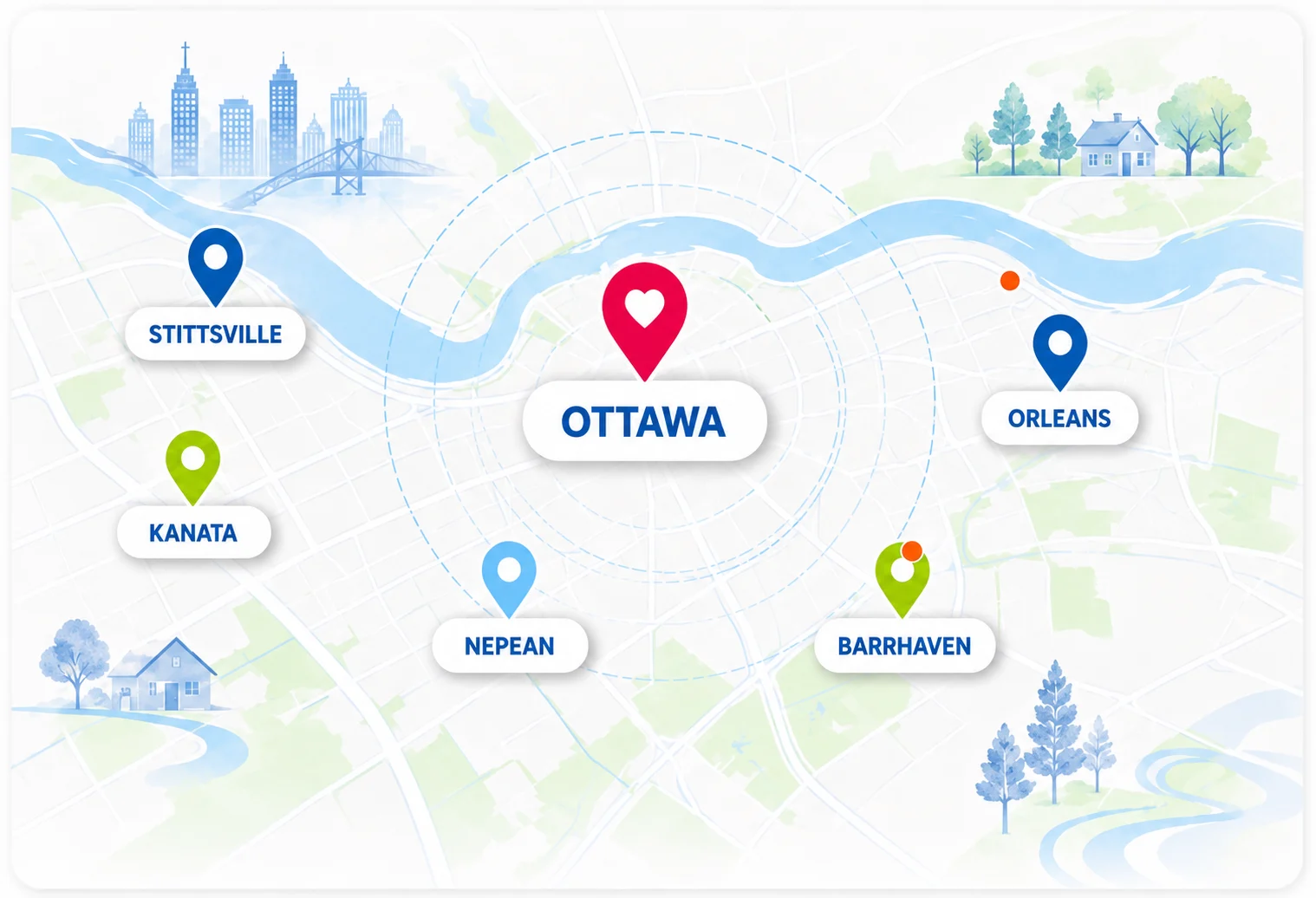
That is the moment we are built for. Freiheit Care provides specialized in-home dementia and Alzheimer’s care across Ottawa, Kanata, Nepean, Barrhaven, Orléans, Vanier, Stittsville, Manotick, Gloucester, and into Gatineau and Aylmer. A registered nurse leads every care plan we write, which means your parent gets clinical judgment — not just companionship — in the place they feel safest.
We support families through the whole arc of the disease: the early stage, when a little structure goes a long way; the middle stage, when wandering and sundowning start reshaping the day; and the late stage, when care becomes continuous and comfort becomes the whole point.
Call 613-518-8258 for a free in-home assessment — a registered nurse comes to you, and there is no obligation.
- OUR COMMITMENT
Dementia and Alzheimer's Are Not the Same Diagnosis — and They Don't Need the Same Care Plan
Dementia is the umbrella. It describes a group of symptoms — memory loss, confusion, difficulty with familiar tasks, changes in judgment, withdrawal from social life, shifts in mood or personality — that interfere with everyday functioning. Alzheimer’s disease is the most common cause of those symptoms, accounting for roughly 60–70% of dementia cases in Canada.
But it is not the only one. Vascular dementia progresses in steps rather than a slow slide. Lewy body dementia brings visual hallucinations and sharp day-to-day fluctuations. Frontotemporal dementia often changes personality and behaviour before it touches memory at all. Many people have a mixed diagnosis.
That distinction matters, because a care approach that settles someone with Alzheimer’s can agitate someone with Lewy body dementia. Our registered nurses build each plan around the actual diagnosis, the current stage, and the person underneath both — their routines, their history, what they still love doing.
- Understanding the Difference
Same disease category. Very different days. Your care plan should reflect that.
- OUR SERVICES
What Our Dementia and Alzheimer's Care Includes
Every plan is assembled from your family’s actual needs — never a package you have to take whole.
Familiar-Face Companionship
Isolation accelerates cognitive decline. Our caregivers sit with your parent, talk with them, look through photo albums, put on the music they grew up with, and keep a real relationship going — not just a shift.
Personal Care With Dignity Intact
Bathing, dressing, grooming, and toileting support, delivered by caregivers trained to work with resistance rather than push through it. How a bath is offered matters as much as whether it happens.
Medication Reminders and RN Management
Missed and doubled doses are among the most common reasons dementia symptoms appear to worsen suddenly. Caregivers provide reminders; where the plan calls for it, a registered nurse manages and administers medication directly.
Meals People Actually Eat
Appetite, taste, and the ability to recognize food all change with dementia. We prepare familiar meals in familiar ways, adjust textures where swallowing becomes difficult, and keep mealtimes on a predictable rhythm.
Structured Days and Cognitive Engagement
Predictability reduces anxiety. Our caregivers build a repeatable daily shape — morning routine, activity, walk, rest — and fill it with reminiscence, gentle crafts, gardening, card games, and conversation that keeps the mind working.
Wandering Prevention and Home Safety
Wandering is one of the most serious risks in dementia, and it rarely announces itself. We assess the home for exit risks, stair and bathroom hazards, and night-time triggers, then supervise accordingly — including overnight.
Sundowning and Behaviour Support
Late-afternoon agitation, repetitive questioning, refusal, and distress are symptoms, not misbehaviour. Our caregivers use gentle redirection, validation, environmental adjustment, and comfort cues instead of correction and argument.
Respite for the Family Caregiver
Scheduled, reliable relief so you can sleep, work, travel, or simply stop being on duty — while your parent's routine continues exactly as it was.
Late-Stage and Palliative Support
As dementia advances, care shifts toward comfort, pain management, dignity, and presence. We stay with families through that stage, and we coordinate with physicians so nobody is navigating it alone.
- Care That Changes as the Disease Does
Support at Every Stage of Dementia
Dementia doesn’t arrive all at once, and care shouldn’t either. Here is how support typically evolves — and how we adjust with it.

Early Stage: Light Support, Maximum Independence
Mild forgetfulness, misplaced items, occasional disorientation, some withdrawal from social plans. Full-time care is not the answer here — structure is. A few hours a week of companionship, medication reminders, meal preparation, and a steady routine can hold independence in place far longer than families expect. This is also the easiest stage to introduce a caregiver, because the relationship gets to form while your parent can still fully participate in building it.

Middle Stage: The Hardest Stretch, and the One We're Built For
This is usually when families call. Wandering starts. Sundowning turns late afternoons into a daily negotiation. Personal care becomes a two-person job. Sleep — yours and theirs — falls apart. Care expands to daily visits, extended hours, or overnight supervision, and a registered nurse reviews the plan more frequently because needs change month to month, sometimes week to week.

Late Stage: Continuous Care, Comfort First
Your loved one now depends on others for most or all daily needs, and often for mobility and feeding. Care becomes continuous — 24/7 rotating caregivers with RN oversight — and the goal shifts from maintaining independence to protecting comfort and dignity. Many families choose to keep this stage at home, and with the right support, that is entirely possible.
Not sure which stage your parent is in?
That's exactly what the free assessment is for. A registered nurse visits your home, evaluates cognition, safety, and daily function, and tells you plainly what level of support makes sense right now.
Dementia Care Shaped by This City, Not a Franchise Manual
- Built for Ottawa Families
We are a family-run Ottawa business, not a national franchise running a template. That shows up in specific ways.
Ottawa Winters Are a Dementia Risk Factor
Ice, early darkness, and five months indoors are not a footnote here. Shorter daylight worsens sundowning; snow and ice multiply fall risk; cabin fever accelerates withdrawal. Our caregivers plan for it — indoor activity that works during a storm week, light management in the late afternoon, safe walkway checks, and routines that hold through February.
Bilingual Care, Because Language Comes Back Before It Goes
As dementia advances, many people revert to their first language. A parent who has spoken English for fifty years may wake up speaking only French — and suddenly a caregiver who can't follow them becomes a source of panic rather than comfort. We provide French-speaking caregivers across Ottawa, Vanier, Orléans, Gatineau, and Aylmer.
We Know Ottawa's Care System
We help families connect with the Alzheimer Society of Ottawa and Renfrew County and its First Link navigation service, coordinate with physicians and memory clinic teams, work alongside Ontario Health at Home where families have public hours, and point families to local adult day programs for additional respite.
Registered Nurse Oversight, Physician Co-Founder
Freiheit Care was co-founded by Dr. Mark Reimer, a physician, and every dementia care plan is supervised by a registered nurse who monitors symptoms, adjusts the plan as the disease progresses, and communicates changes directly to your family. That is a clinical layer most non-medical home care agencies simply don't have.
Veterans With Dementia
Canadian veterans living with dementia or Alzheimer's may be eligible for funded home care through Veterans Affairs Canada. We are a VAC-approved provider and handle the coordination, so your family can spend the time on visiting instead of paperwork.
Ready to talk it through?
A free in-home assessment with a registered nurse. No obligation, no pressure.
For Someone With Dementia, a New Caregiver Every Week Is Not an Inconvenience — It's a Setback
For most home care clients, a substituted caregiver is a minor annoyance. For someone with dementia, it can undo weeks of progress. Every new face means re-establishing trust with a stranger, re-learning a routine, and re-triggering the anxiety that a settled routine had finally calmed. Families see it immediately: more agitation, more refusal, worse nights.
Caregiver turnover is the single biggest quality problem in this industry, and it has a boring, unglamorous cause — pay. When caregivers are underpaid, they work multiple jobs, burn out, and leave. Then your parent starts over with someone new.
In May 2026, Freiheit Care was certified as a Champion Level Living Wage Employer by the Ontario Living Wage Network — the highest tier available in Ontario. We pay above the living wage, we pay mileage between client visits, and we build toward full-time hours with benefits.
We didn’t do that as a marketing exercise. We did it because it is the only reliable way to keep good caregivers, and keeping good caregivers is the only reliable way to give your parent the same familiar face on Thursday that they had on Monday.
- Why Consistency Is Clinical
Fair pay → caregivers stay → your parent sees the same person → trust builds → fewer difficult days. That chain is the whole product.
- AREAS WE SERVE
In-Home Dementia Care Across Ottawa, Gatineau, and the Surrounding Region
- Ottawa (city-wide)
- Kanata
- nepean
- Barrhaven
- Orleans
- Gloucester
- Alta Vista
- Sandy Hill
- Manotick
- Kemptville
- Arnprior
- Ottawa (city-wide)
- Kanata
- nepean
- Barrhaven
- Orleans
- Gloucester
- Alta Vista
- Sandy Hill
- Manotick
- Kemptville
- Arnprior
We deliver dementia and Alzheimer’s care wherever your loved one lives — their own home, a family member’s home, a retirement residence, or an assisted living suite where the built-in staffing isn’t enough for dementia-level needs.
Bilingual caregivers available — French-language dementia care across Vanier, Orléans, Gatineau, and Aylmer.
Many of the families who call us are managing a parent’s care from Toronto, Montreal, or further. We send updates after every visit, so distance doesn’t mean guessing.
- Getting Started
What Happens After You Call

One Honest Conversation
Call 613-518-8258 or send the form. A care coordinator listens to what's actually happening — the falls, the nights, the fight about the shower — and books a free in-home assessment. No pressure, no obligation, no sales script.

A Registered Nurse Comes to the House
The assessment covers cognition, physical needs, safety risks in the home, and where your family actually is emotionally and financially. You get a straight recommendation about the level of care that makes sense — even if that recommendation is fewer hours than you expected.

We Match, Then We Start
We match your parent with a caregiver on skills, personality, and language — then keep that caregiver consistent. In most cases care begins within days. For urgent situations like a hospital discharge or a sudden decline, we move faster.

- FREQUENTLY ASKED QUESTIONS
Dementia and Alzheimer's Care in Ottawa — Your Questions Answered
Dementia is an umbrella term for symptoms that affect memory, thinking, and daily functioning. Alzheimer's disease is the most common cause of dementia, making up roughly 60–70% of cases in Canada. Other causes include vascular dementia, Lewy body dementia, and frontotemporal dementia. Each progresses differently and responds to different care approaches, which is why our registered nurses build plans around the specific diagnosis rather than a generic dementia template.
The common signals are practical, not medical: leaving the stove on, missing or doubling medications, wearing the same clothes for days, unopened mail, weight loss, getting lost on familiar routes, wandering at night, or new resistance to bathing. There is also a signal on your side — if you are exhausted, anxious at every phone call, or arguing with your parent more than you used to, that counts. A free assessment can tell you where things actually stand.
Both are legitimate choices, and the right one depends on the family. What research consistently shows is that familiar surroundings reduce confusion, agitation, and anxiety in people living with dementia — the same kitchen, the same chair, the same view from the window all carry memory that a new room does not. A move also carries a real transition cost that can set someone back significantly. With enough support at home, including 24/7 care where needed, many families find they don't have to make the move at all.
Usually the late stage, when supervision has to be continuous and daily needs require hands-on help around the clock. But some families need overnight care much earlier — often in the middle stage, when wandering or sundowning makes nights unsafe. We scale hours up gradually rather than jumping straight to 24/7, and the RN reassessment tells you when it's time.
It depends on hours per week and the level of care — companionship-focused visits cost less than continuous care with nursing involvement. We give you a transparent, itemized quote after the free assessment, with no hidden fees. Some families are eligible for funded hours through Veterans Affairs Canada or Ontario Health at Home, and many use private insurance or long-term care insurance toward the cost. We'll tell you what applies to your situation.
Yes. Every caregiver is vetted, insured, bonded, police-checked, and trained specifically in dementia care — redirection, validation, sundowning management, communication techniques for different stages, and responding to behavioural change without escalation. Every plan is supervised by a registered nurse, and our co-founder Dr. Mark Reimer is a physician.
Yes. This matters more in dementia than in most services, because people often revert to their first language as the disease progresses — a parent who spoke English for decades may suddenly be comfortable only in French. We provide bilingual caregivers across Ottawa, Vanier, Orléans, Gatineau, and Aylmer.
Yes — these are two of the most common reasons families reach out. For wandering, we assess exit risks and hazards in the home and provide supervision, including overnight. For sundowning, our caregivers manage light and noise in the late afternoon, keep the day's routine predictable, and use redirection and comfort cues rather than correction, which usually makes agitation worse.
This is one of the most common things families tell us, and it is rarely permanent. Refusal is usually about control and dignity, not about the caregiver. We start small — short, low-pressure visits framed around company rather than care, doing something your parent actually enjoys. Once the relationship exists, the care tasks follow naturally. Matching matters enormously here, which is why we take time over it.
Yes, for eligible veterans. Freiheit Care is a VAC-approved provider, and we handle the coordination directly so your family isn't chasing paperwork. If you're unsure whether your parent qualifies, call us — we'll help you find out.
We serve Ottawa city-wide, including Kanata, Nepean, Barrhaven, Orléans, Vanier, Stittsville, Gloucester, Manotick, and the Glebe, as well as Kemptville and Arnprior, and Gatineau and Aylmer in Quebec. We provide care in private homes, family homes, retirement residences, and assisted living suites.
Usually within a few days of the in-home assessment. For urgent situations — a hospital discharge, a fall, a sudden change in behaviour, or a family caregiver who has simply hit the wall — we can move faster. Call and tell us the timeline you're working with.
- WHAT FAMILIES ARE SAYING
Trusted. Loved. Recommended.
Real stories from Ottawa families who trust Freiheit Care for compassionate, RN-led care at home.
5.0
Average Rating
2019
Serving Ottawa Since
RN-Led
Clinical Oversight
100%
Vetted & Insured Caregivers
- Take The First Step
Book a Free In-Home Dementia Care Assessment
- Our Commitment
Tell Us How We Can Help
You do not need a diagnosis, a referral, or a decision already made to call us. Most families reach out somewhere in the middle of figuring it out, and that is exactly the right time.
A registered nurse will come to the home, look at cognition, safety, and daily function, and give you a straight answer about what level of support makes sense — including whether you need less than you think. There is no cost and no obligation.
- Canadian Family-Owned
- RN-Led Care
- Dementia-Trained Caregivers
- Insured & Bonded
- No Obligation Consultation

Call Us Anytime
613-518-8258
Speak directly with our care team.
No call centers, no hold music.
We’re here when you need us.

Book a Free Consultation
RN-led, in your home

A registered nurse evaluates cognition, safety, and daily needs, then builds the plan around them.